Drywall vs. Framing: What Has to Come Out
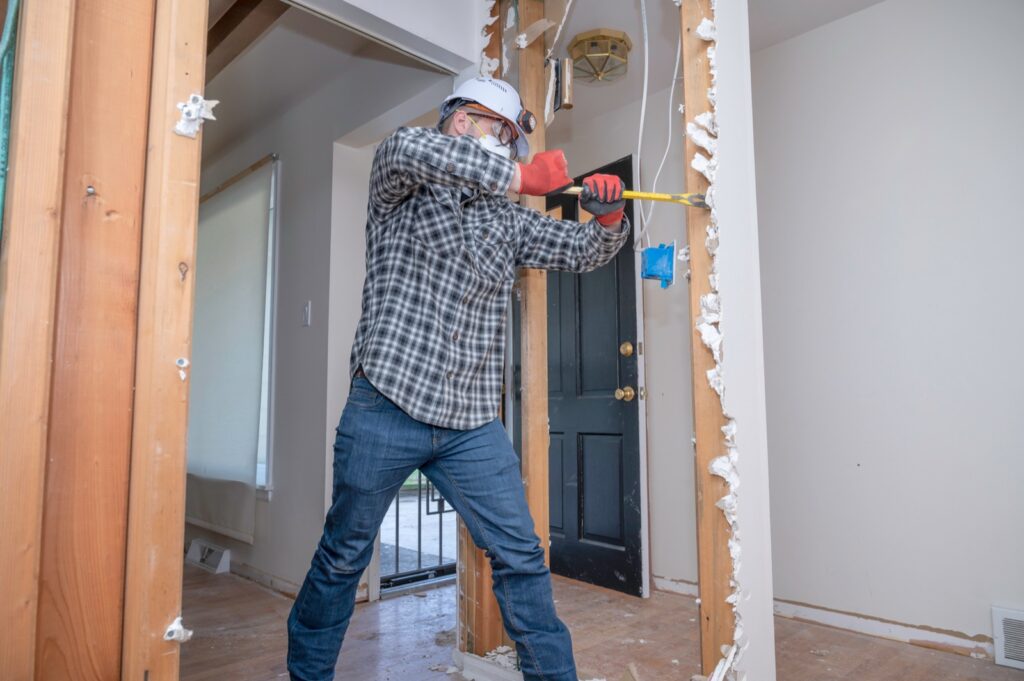
If you only understand one thing about what mold remediation costs, make it this: the price is decided less by where the mold is than by what has to come out. Two jobs in the same room, the same size, can differ threefold — and the fork is almost always the same question. Can the contaminated material be cleaned and kept, or does it have to be removed and rebuilt? Drywall and framing are where that question gets answered, so they’re worth understanding before you read any quote.
A single-room surface clean runs about $808; a whole-house material removal runs into five figures. The spread is the removal decision, not the address. Pick your metro for local figures.
Cleaned & kept — framing
Porous vs. non-porous: the rule that decides the bill
Remediators sort building materials by how deeply mold can root into them, and that sorting is what drives the removal decision.
- Porous materials get removed. Drywall, insulation, carpet and pad, ceiling tile, and paper products are absorbent, and mold grows into them — especially the paper facing on drywall, which is essentially food. You can’t reliably clean the growth back out, so contaminated porous material is cut out and thrown away. This is the demolition-and-rebuild half of a job.
- Non-porous and semi-porous materials get cleaned. Solid-wood framing, concrete, masonry, metal, tile, and glass don’t absorb the same way. Mold grows on the surface, where it can be HEPA-vacuumed, sanded or wire-brushed if needed, treated, and encapsulated — and the material stays in place. This is the clean-and-save half.
So the same wet wall can be a cleaning job or a demolition job depending on what it’s made of — and finished walls are made of both: a porous drywall skin over savable wood framing.
Why drywall almost always comes out — and framing usually doesn’t
When mold reaches a finished wall, the drywall is removed to a set line — commonly a foot or two above the highest visible growth or water line, the so-called “flood cut” — because the paper facing is contaminated past the point of cleaning and the cavity behind it needs to be opened, dried, and inspected anyway. The insulation in that cavity comes out with it.
The framing behind, by contrast, is usually saved. Studs, plates, and joists are structural and non-porous enough to clean: the crew HEPA-vacuums them, sands or media-blasts heavy growth, treats the wood, and dries it before anything is closed back up. Framing is only replaced when it’s rotted or structurally compromised — and that’s the jump that turns a mid-range job into a big one, because it brings a carpenter and structural work into what was a remediation.
Signs there’s mold in the wall
Drywall often hides mold on its back side, so the surface can look fine while growth spreads in the cavity. Watch for:
- Staining, bubbling, or a soft spot on the drywall — often low on the wall, near a window, or on a plumbing wall;
- A musty smell with no visible growth;
- Discoloration spreading outward from a known leak;
- Warped trim or baseboard.
When the surface hints at more underneath, opening a small section is how a contractor confirms whether it’s a drywall-only job or reaches the framing.
Contamination class: how far, and behind what
The industry standard (IICRC S520) frames the size of a job by condition, not square footage: normal fungal ecology, settled spores from a nearby source, or actual active growth. The practical version for a homeowner is two questions:
- How far has it spread? A stain around one leak is a spot repair. Growth that has tracked along a wall cavity, a floor, or a ceiling means more material out, more containment, more hours.
- Is it behind finished surfaces? Growth on the face of a wall is cheap to reach. Growth behind the drywall, under the flooring, or above the ceiling has to be uncovered before it can be removed, and the uncovering is much of the labor.
These two together explain why contamination class drives price harder than the footprint of the room — and why a good remediator spends time diagnosing extent before quoting.
What the removal actually adds to a job
When material has to come out, several costs arrive together: the labor to demolish and bag it, containment and negative air to keep the demolition from spreading spores, disposal and tipping fees for the debris, the drying of the now-open cavity, and finally the rebuild — new drywall, insulation, flooring, trim, and paint. The remediation covers the first four; the rebuild is a separate line, and it’s often the larger one. This is why a $3,000 remediation and a $6,000 project can describe the same wall: one number is the removal and cleaning, the other includes putting the room back.
How to read any quote through this lens
Whatever the scope — a bathroom, a basement, an attic — ask the same three things:
- What’s being removed versus cleaned? The porous/non-porous split should be explicit. If everything is “removed,” ask why the framing can’t be saved; if nothing is, ask how they know the drywall is only surface-contaminated.
- How far are you cutting, and why? The flood-cut line should have a reason — a water line, a moisture-meter reading — not a guess.
- Is the rebuild separate? It almost always is, and it belongs on its own line so you can compare remediation to remediation.
Keeping it from coming back
Whether the fix is drywall alone or drywall plus framing, it only holds if the water is gone first:
- Find and fix the source — a leak, a failed seal, or a humidity problem — before the wall is closed back up;
- Dry the cavity fully before rebuilding;
- Address recurring condensation on exterior walls with insulation and air sealing.
Find your local number
Because so much of the price is labor — demolition, containment, cleaning, drying — it moves with local wages. Choose your metro for modeled ranges across every scope, from a single-room surface clean to a whole-house removal, and use them to read your quote with the removal decision in mind. The scope guides apply this same logic room by room.
Common questions
Does moldy drywall always have to be removed?
Usually, yes. Drywall is porous, so once mold has grown into it, cleaning the surface rarely reaches the growth inside — the affected section is cut out and replaced. Non-porous framing behind it can more often be cleaned and kept.
How much does it cost to remove moldy drywall and framing?
It depends on how much material comes out and how much is rebuilt; the modeled range here reflects local labor. The removal is the remediation scope; replacing drywall and finishes afterward is a separate rebuild cost.
Can I cut out moldy drywall myself?
A small, isolated area under about 10 square feet can be a do-it-yourself job per EPA guidance, with the right precautions. Larger areas, or growth that has spread into framing or behind finishes, are stronger reasons to use a professional.
What decides whether framing is replaced or cleaned?
Extent and structural condition. Surface mold on sound framing is typically cleaned and treated; wood that is soft, rotted, or structurally compromised is replaced. A contractor assesses this once the drywall is open.
How do I prevent it from happening again?
Fix the water source — a leak, a failed seal, or a humidity problem — before the wall is closed back up. Remediation without the moisture fix is a repeat visit.
More cost guides
Attic Mold Remediation Cost
What drives the price of attic mold remediation — ventilation, roof leaks, and how much sheathing has to come out.
Read →Basement Mold Remediation Cost
Finished vs. unfinished is the biggest lever in a basement mold job — plus drainage, contamination class, and what a…
Read →Bathroom Mold Remediation Cost
Most bathroom mold is a surface job; the cost jumps only when water gets behind the tile or drywall. How…
Read →Crawl-Space Mold: What Remediation Costs, and Why
The crawl space is where mold remediation gets expensive. It’s the scope that most often turns a four-figure job into…
Read →HVAC & Ductwork Mold Remediation Cost
Mold in the coil, air handler, and ductwork — clean vs. replace, the moisture source, and how to read an…
Read →